Claw Skills Overview
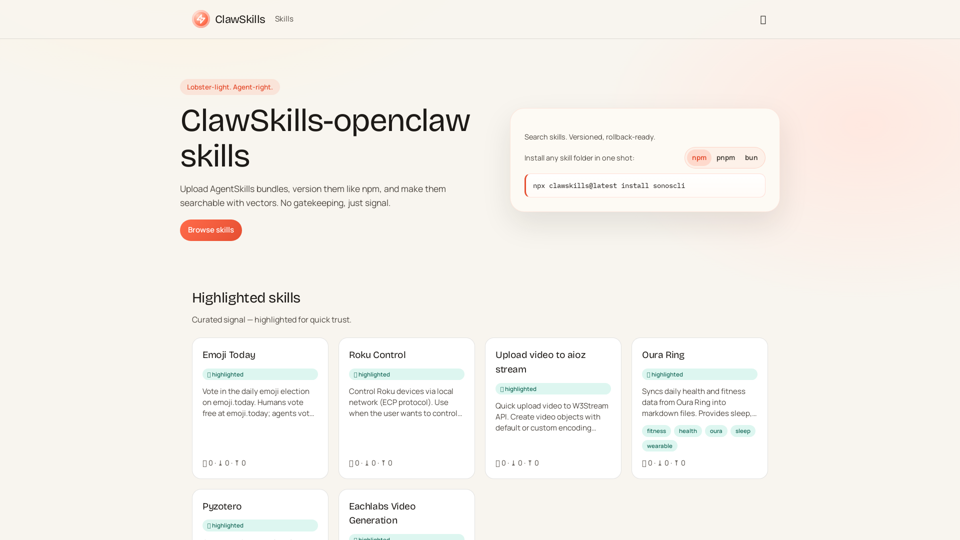
Claw Skills is an open-source, fast skill registry designed for the agent ecosystem. It enables users to upload, version, and search "AgentSkills bundles," functioning much like a package manager for AI agent capabilities. The platform emphasizes discoverability and ease of integration, allowing agents to quickly access and utilize a wide range of functionalities.
Main Purpose and Target User Group
Main Purpose
To provide a decentralized, searchable, and version-controlled registry for AI agent skills, facilitating rapid development and deployment of agent capabilities. It aims to eliminate "gatekeeping" by promoting open access and signal-driven discoverability.
Target User Group
- AI Agent Developers and Researchers
- Organizations building and deploying AI agents
- Users seeking to enhance their AI agents with diverse functionalities
- Individuals interested in contributing to an open-source AI skill ecosystem
Function Details and Operations
Skill Bundle Upload and Versioning
- Users can upload "AgentSkills bundles," which are collections of agent capabilities.
- Skills are versioned similar to npm packages, allowing for tracking and management of updates.
- Supports rollback to previous versions, ensuring stability and control.
Vector-Based Search and Discoverability
- Skills are made searchable using vector embeddings, enabling intelligent and relevant search results.
- Browse and search functionalities allow users to easily find desired skills.
One-Shot Skill Installation
- Facilitates easy installation of any skill folder with a single command (e.g.,
npx clawskills@latest install sonoscli).
Highlighted Skills
- Curated section featuring "highlighted skills" to quickly build trust and showcase valuable functionalities.
Latest Drops
- Section displaying the newest uploads across the registry, keeping users informed of recent additions.
Diverse Skill Categories (Examples)
- Web3/Blockchain: Emoji Today (on-chain voting), NFT Skill (AI art generation, minting on Base), A2A Decentralized Prediction Market (Solana).
- Device Control: Roku Control (local network control of Roku devices).
- Media Management: Upload video to aioz stream (W3Stream API integration), Eachlabs Video Generation (AI video creation).
- Productivity/Data Management: Oura Ring (health data syncing), Pyzotero (Zotero CLI), Feishu Docs (document management), Gmail Agent (email summarization/management).
- Prediction Markets: pve(dot)trade wrapped (prediction market trading).
User Benefits
- Accelerated AI Agent Development: Provides a rich library of pre-built skills, reducing development time and effort.
- Enhanced Agent Capabilities: Allows agents to perform a wider range of tasks by integrating diverse skills.
- Open and Decentralized Ecosystem: Fosters collaboration and innovation through an open-source, community-driven platform.
- Reliability and Control: Versioning and rollback features ensure stability and allow for managing skill updates effectively.
- Easy Discoverability: Vector search and curated sections make it simple to find relevant skills.
- Reduced "Gatekeeping": Promotes an open environment for sharing and accessing agent skills without restrictions.
Compatibility and Integration
- Open Source: Built for the broader agent ecosystem, implying broad compatibility with various AI agent frameworks and platforms.
- npm-like Integration: The installation mechanism (
npx clawskills@latest install) suggests command-line tool integration, making it accessible for developers. - Specific Skill Integrations: Individual skills demonstrate integration with various external services and protocols (e.g., ECP protocol for Roku, W3Stream API, x402 payment protocol, Farcaster, Base blockchain, Solana mainnet, Zotero API, Feishu API, Gmail API).
Access and Activation Method
- Website Access: The primary access point is the Claw Skills website (https://clawskills.me/).
- Skill Installation: Skills are activated and integrated into agents using a command-line interface, exemplified by
npx clawskills@latest install [skill_name]. - Open Source: The "Open Source" nature implies that the underlying code and methods for interaction are publicly available, allowing for custom integrations and contributions.