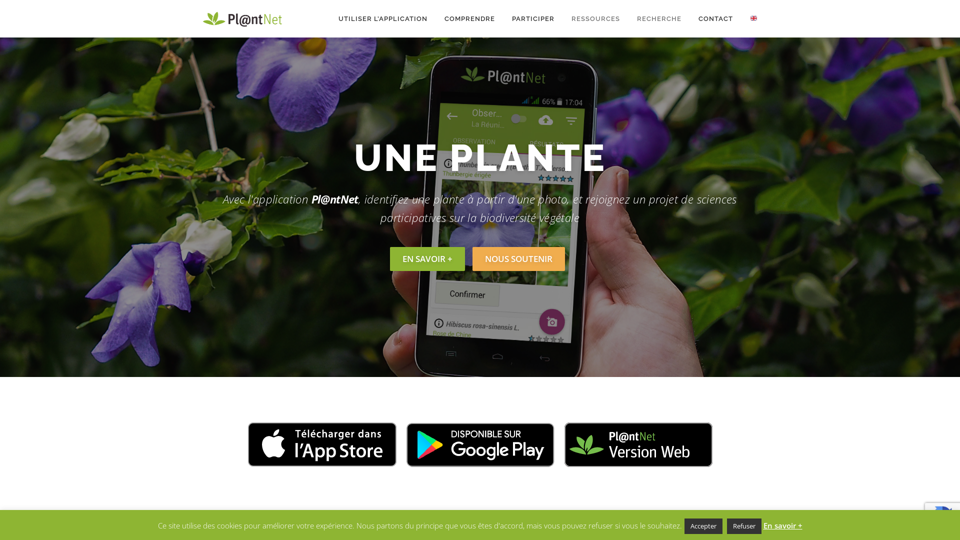
With the Pl@ntNet app, identify a plant from a photo, and join a citizen science project on plant biodiversity

Home - Pl@ntNet

Introduction

What is Pl@ntNet?

Pl@ntNet is a participatory science project that helps identify plants based on photos. It is an application that allows users to contribute to the understanding of plant biodiversity.

How can I use Pl@ntNet?

To use Pl@ntNet, simply take a photo of a plant, and the application will help identify the species. You can also contribute to the project by submitting your observations and helping to improve the application.

Features of Pl@ntNet

  • Identify plants based on photos
  • Contribute to the understanding of plant biodiversity
  • Participate in a collaborative project to improve the application
  • Access a vast database of plant species
  • Use the application offline to identify plants anywhere

Pricing of Pl@ntNet

Pl@ntNet is a free application, and users can contribute to the project without any cost. However, donations are welcome to support the project and ensure its continuity.

Note: The content is based on the provided template and the website content of Pl@ntNet.

Home - Alternative

Undress AI tool - create Deepnude image for FREE

Undress Ai Tool: the best free Deepnude Ai application that allows you to easily undress anyone in images using our powerful Photo Undresser tool for Ai Nudes right now!

--
AI Stripper - Create Deepnude Images for FREE

Undressing Ai Tool: Now the best free Deepnude Ai application to smoothly undress everyone in images with our powerful photo undressing tool for Ai Nudes!

--
Upscale Image for Stunning Visuals with AI | Enhance photos up to 4K Resolution

Upscale your images with our AI-powered upscaler. Increase resolution, improve quality, and restore old photos online!

--
Drag Your GAN: Interactive Point-based Manipulation on the Generative Image Manifold

Synthesizing visual content that meets users' needs often requires flexible and precise controllability of the pose, shape, expression, and layout of the generated objects. Existing approaches gain controllability of generative adversarial networks (GANs) via manually annotated training data or a prior 3D model, which often lack flexibility, precision, and generality. In this work, we study a powerful yet much less explored way of controlling GANs, that is, to

--
More Tags about: Home - Pl@ntNet