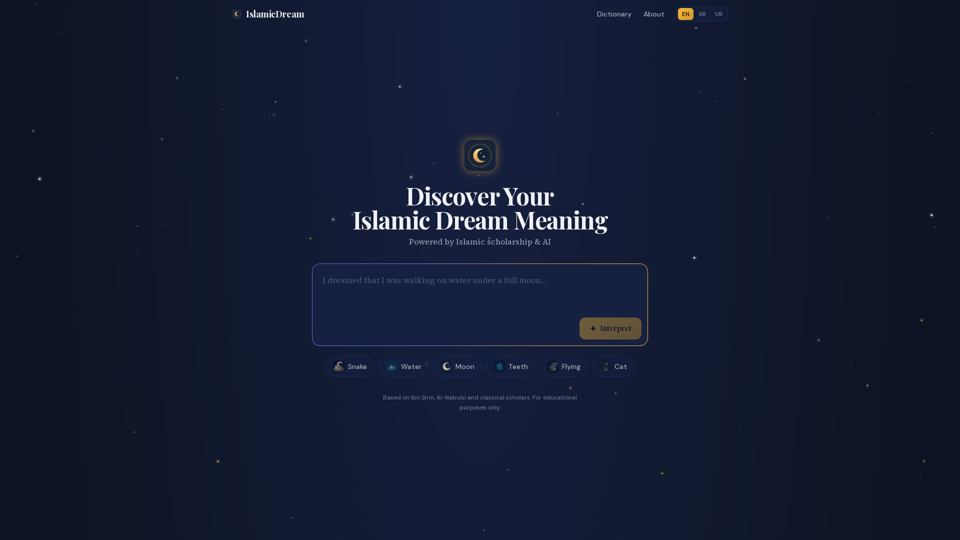
Islamic Dream Platform
Overview
Islamic Dream is an AI-powered platform dedicated to providing authentic Islamic dream interpretations. It combines classical Islamic scholarship, drawing from renowned scholars like Ibn Sirin and Al-Nabulsi, with modern artificial intelligence to offer personalized and contextually rich dream analyses. The platform aims to make the profound science of Tabir al-Ru'ya accessible to a global audience.
Main Purpose and Target User Group
-
Main Purpose
To offer accurate and scholarly-backed Islamic dream interpretations, helping users understand the spiritual and symbolic meanings of their dreams according to Islamic tradition. It serves as an educational tool to bridge classical knowledge with contemporary accessibility. -
Target User Group
Muslims and individuals interested in Islamic dream interpretation, seeking to understand their dreams from an Islamic perspective. This includes those who value traditional scholarship and appreciate the convenience of AI technology.
Function Details and Operations
-
Dream Description Input
Users can describe their dreams in their own words, in any language and of any length, through a user-friendly interface. -
AI-Powered Analysis
The platform's AI engine processes the user's dream description. -
Scholarship Integration
The AI draws upon a vast database of classical Islamic dream interpretation sources, including the works of Ibn Sirin, Al-Nabulsi, and Ibn Qayyim al-Jawziyyah, as well as relevant Quranic verses and authentic Hadith. -
Personalized Interpretation Output
Users receive a detailed and personalized interpretation of their dream, grounded in centuries of Islamic scholarship. -
Popular Dream Symbols Section
A dedicated section showcasing interpretations of common dream symbols (e.g., Water, Snake, Moon, Death, Flying, Teeth Falling Out, Gold, Prayer, Lion, Fire, Baby, Horse), providing quick insights and educational content. -
Educational Content
Provides information on "What Is Islamic Dream Interpretation?", explaining its roots in the Quran and Sunnah, and highlighting the contributions of classical scholars. -
Scholar Profiles
Features brief biographies and contributions of key Islamic dream scholars like Ibn Sirin, Abdul Ghani al-Nabulsi, and Ibn Qayyim al-Jawziyyah. -
FAQ Section
Addresses common questions about Islamic dream interpretation, including types of dreams in Islam, the importance of Ibn Sirin, Quranic references to dream interpretation, actions after a bad dream, and the role of AI.
User Benefits
-
Authentic Interpretations
Access to interpretations rooted in classical Islamic scholarship, ensuring accuracy and adherence to traditional principles. -
Personalized Insights
Receive interpretations tailored to the specific details of their dreams. -
Educational Value
Learn about the rich history and methodology of Islamic dream interpretation. -
Convenience
Easily interpret dreams anytime, anywhere, without needing to consult physical texts or experts. -
Spiritual Guidance
Gain a deeper understanding of potential spiritual messages, warnings, or glad tidings within their dreams. -
Accessibility
Makes complex scholarly knowledge accessible to a broader audience through modern technology.
Compatibility and Integration
-
Web-Based Platform
Accessible via any web browser on various devices (desktops, laptops, tablets, smartphones). -
Multi-language Input
Supports dream descriptions in any language, enhancing global accessibility. -
AI Technology
Leverages advanced AI for sophisticated textual analysis and interpretation.
Access and Activation Method
-
Direct Website Access
Users can access the service directly through the website (islamicdream.net). -
Simple Input Process
Users activate the interpretation process by describing their dream in a text box and initiating the AI analysis.